
Game Theory: Shallow Sea – Great Barrier Reef

Our duo Dr Louise Robinson and Dr Ian Turner deep dive into Shallow Sea – Great Barrier Reef.
WHAT IS SHALLOW SEA?
The Great Barrier Reef is the world’s largest coral reef system, spanning over 344,400 km² off the coast of Australia, home to thousands of species and a UNESCO World Heritage Site. It is here that Shallow Sea centres its game play. Players need to create their own beautiful landscape moving around the adorable fish meeples, other marine life, and of course corals. You win by collecting victory points which are awarded for a range of things like completing conditions on ecosystem cards, tiles and the diversity of sea life.
IS IT EDUCATIONAL?
The game itself showcases the complexity of ecosystems and includes a wide range of species found in the Great Barrier Reef. The instruction manual has a ‘Shallow Sea Encyclopaedia’ that has lovely little descriptions of everything in the game. You can learn about the wonderful ‘pom-pom crab’ named because of its habit of carrying anemones in its claws, or ‘Anna’s Magnificent Sea Slug’ that has a vibrant and colourful appearance but is rather toxic to anything that takes a bite.
IS IT FUN?
Shallow Seas is certainly fun; on your turn you have a range of decisions to make. This begins with selecting a tile and fish from the pool, which with 10 possible combinations and impacted by the board gives a hint at the complexity of the game. Tiles are placed in your ocean and, depending on whether you meet conditions, grant you seashells which in turn can be used to move around fish.
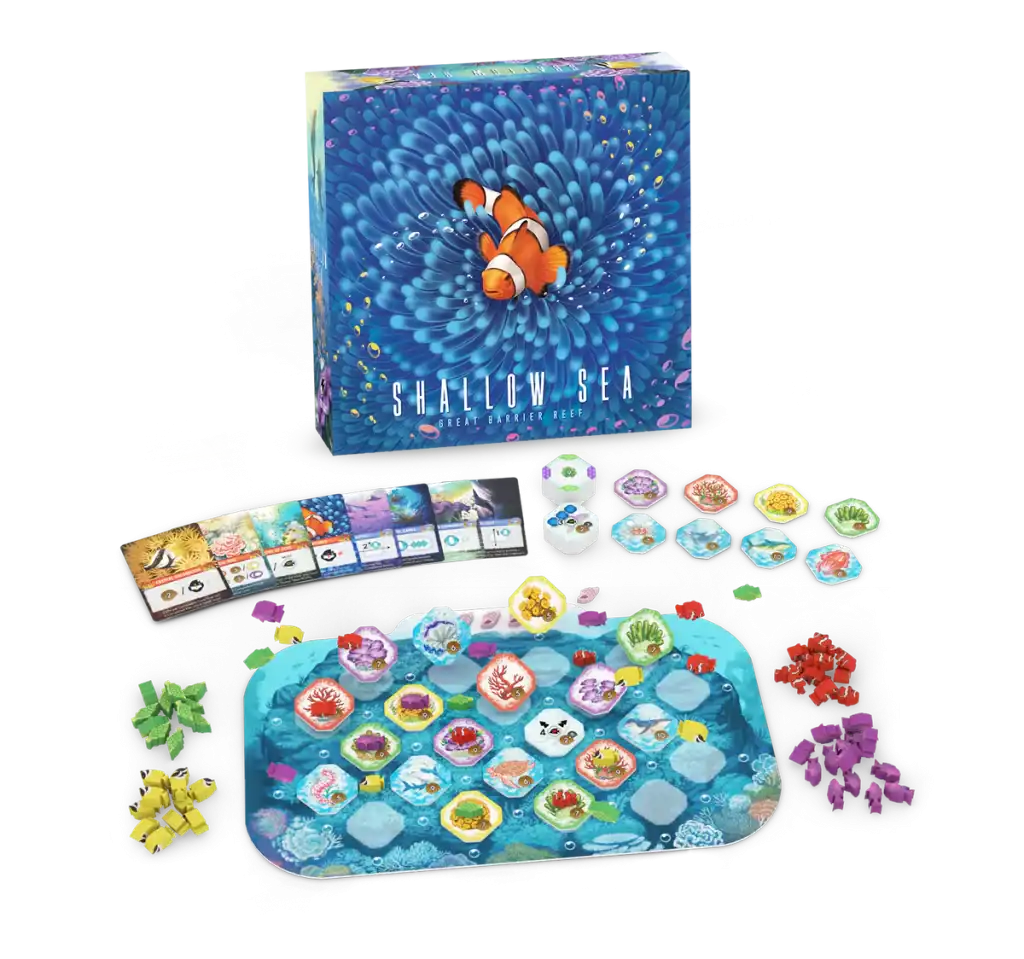
The ability to move around components really keeps players on their toes and creates lots of dilemmas. A real nice touch in the game is the range of different modes. In addition to the more commonplace family and solo modes, there is also an excellent achievement mode which increases the longevity of the game.
CONCLUSION
This game is really great to play. With such a wide range of interactions on each turn that activate and deactivate potential scoring pieces, it is a tense affair. This combined with the range of game modes and the beautiful pieces make this game an excellent addition to your collection.
DETAILS
- Age 10+
- 1-4 players
- 30-45 minutes
- Bad Comet Games
- Dr Louise Robinson is senior lecturer in forensic biology and Dr Ian Turner is professor in learning and teaching at the University of Derby

