A world’s first in proton beam research
Apologies for the newsletter misdirect if you were looking for Biophilic building for human resilience and pandemic prevention please click here otherwise do read on. . . Just before the first lockdown, a major collaborative project came to fruition when the world's first high energy proton beam workstation was delivered to the NHS therapy centre that is now using it for critical cancer research. Here, Evan Kitsell, David Boast and Karen Kirkby, tell us the story of how this collaboration came about.
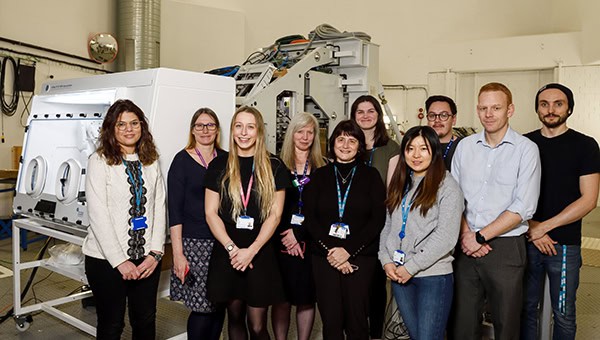
Image: The team involved in the Manchester Proton Beam Project
The PRECISE Group at the University of Manchester, The Christie NHS Foundation Trust and Don Whitley Scientific recently announced the world's first Proton Radiobiology Modified Atmosphere Workstation with integrated robotic arm, which will be used for research into cancer treatments. The Proton Beam Therapy Centre at The Christie, Manchester, is the first NHS high energy proton beam therapy centre in the UK. Within the facility there is a dedicated research room, which was funded by The Christie Charity, where this new Whitley Workstation will be operated. The workstation with its integrated robotic arm was funded by CRUK Manchester Major Centre funding.
Although the project has only recently been announced publicly, by a twist of fate, delivery of the finished workstation took place a few days before the start of the first national lockdown!
We collaborated very closely with the Manchester team to define precisely what was required and realised that the most effective way to expedite this project was to extensively customise one of our existing workstations.
David Boast, DWS Product Development Engineer on the project, said, "There were several challenges associated with the project, ensuring that we could create a clear path for the beam through the workstation. The proton beam needed to pass through the workstation without hitting the robot, the sample 'hotel' or any of the workstation operating hardware. The DWS product design and development team routinely make use of Autodesk Inventor, an industry standard, powerful, solid 3D modelling package. However, in addition, this project benefited from a surprisingly large number of cardboard and wooden models and test rigs, prior to finalising the design in Inventor. Evan and I enjoyed working on this unusual project. We produced models of the robot and associated accessories, including a sample holding 'hotel' and a washing station. During a number of project meetings with the PRECISE Group and the supplier of the robot, we worked together to ensure that every area that could have caused difficulties was resolved sensibly."
DWS Design Director, Evan Kitsell, commented, "We were delighted to be invited by the PRECISE Group at the University of Manchester to collaborate with them in developing the first modified atmosphere workstation of this type. We worked very closely with them to ensure that their preferred protocol could be accommodated in a Whitley Workstation. It's humbling to know that this project will accelerate an understanding of the best way to utilise PBT in the ongoing fight against cancer."
Kitsell continued,"We developed a close rapport with the team at Manchester who were clearly knowledgeable, dedicated and as committed as we were to ensure that we got the best possible outcome. Part of our role was to make visible what might otherwise have been a somewhat abstract concept and by the use of a mix of traditional model making techniques and modern, contemporary product development tools, the PRECISE Group and ourselves worked towards a successful conclusion. On a personal level, this was a really enjoyable and interesting project to be involved with and one where Dave and I were humbled to realise we could contribute in a significant way to the fight against cancer."
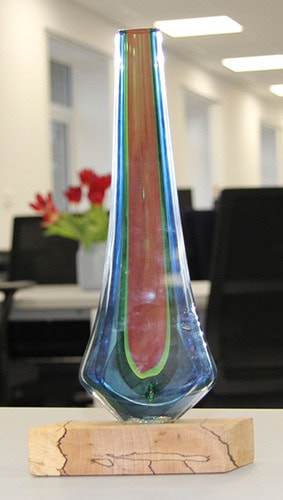
Image: an original hand-blown glass sculpture of a Bragg Peak
Contributors: David Boast is a Product Development Engineer and Evan Kitsell is Design Director for Don Whitley Scientific. Professor Karen Kirkby is from the University of Manchester and The Christie
Related Content
When plasma leaves the laboratory
The orbital laboratory is evolving into something more ambitious, a controlled industrial environment for producing next-generation materials, explains Ed Smith and Andrew Griffiths. …

Maths award adds up to nearly £2.8 mill for exchange research
Two of Sweden’s leading institutions have donated the equivalent of £2.78 million to fund 16 mathematicians for work ranging from …
London Lab Live: A capital investment
Launched last year as part of the Future Labs’ stable, the London show looks here to stay. One year on, …