
A guide to enjoying a lab brew

The tea break can be the only thing that keeps you going during those painfully long and repetitive experiments. But enjoying the humble cup of tea might be trickier than you thought…
The first time a human found that putting bits of bush into water and boiling it over a fire made a slightly bitter drink was an important moment in human history. From there, human society developed whilst fiercely defending hot water-making fire with sharpened sticks. The next several thousand years has all been about collecting more leaves, making better fire and wielding sharper sticks.
But despite the millennia of tea drinking, often, making something as fundamental as a brew is fraught with difficulty. So here are a few tips…
- Find a mug
So most people have their own, and the sensible ones make sure that it is GPS tracked and secured with a claymore based defence system.
- Find tea
The obvious solution to this is to have brought your own tea bags, which, like the mug, you carefully guard and protect from co-workers.
- Find hot water
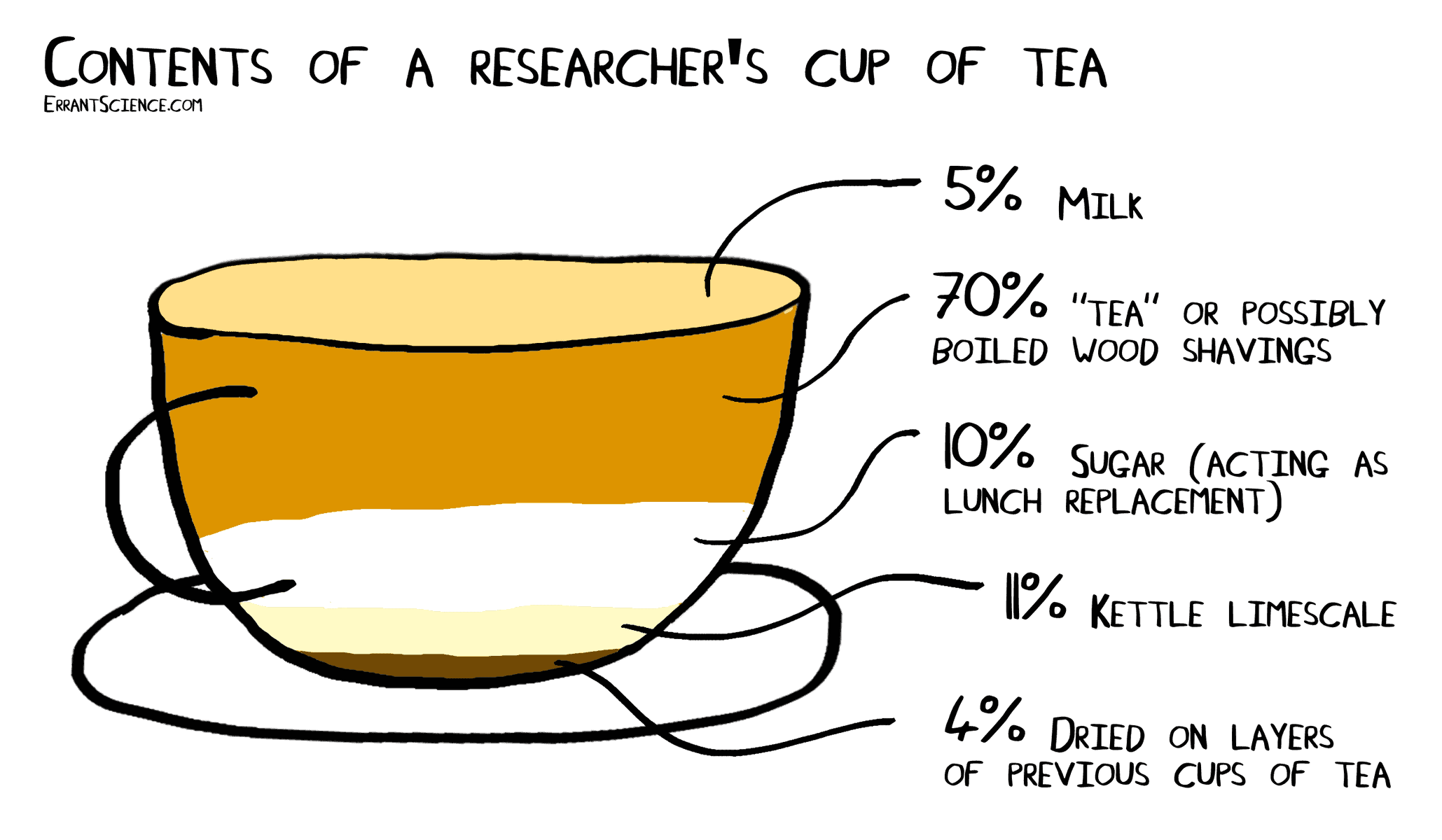
Shared kettles mean shared cleaning – which means no cleaning. Every shared kettle is about half cheap plastic and half limescale. Being cheap and covered in limescale this makes the average kettle about as safe to use as a live grenade being repeatedly hit with a hammer – so caution is recommended.
- Find a place to make it
- Drink
Author:

Dr Matthew Partridge is a senior Research Fellow at the Optoelectronics Research Centre at the University of Southampton but describes himself as a biochemist who has accidentally ended up working with optical sensor systems.
Related Content

Gatsby: a benchmark for STEM success
The Gatsby Foundation’s benchmarks are helping transform school careers guidance. Good news for STEM employers, says Rachel Bibby, who explains …

Moon myths: Artemis in proportion
Curious how space science is always exaggerated. If there’s a meteor shower due, when you might see a fleeting shooting …

When plasma leaves the laboratory
The orbital laboratory is evolving into something more ambitious, a controlled industrial environment for producing next-generation materials, explains Ed Smith and Andrew Griffiths. …

