Controlling polymorphism
Using particle shape to identify different polymorphic crystal forms
Using particle shape to identify different polymorphic crystal forms
CHEMICAL compounds that can exist in more than one crystal form are described as polymorphic. Different crystal polymorphs of a substance can have different physical and chemical properties, so understanding and controlling polymorphism is critical for certain processes. Properties such as melting point, solubility and crystal habit, which in turn influence parameters such as stability, bioavailability and flow behaviour, are frequently a function of polymorphic form. In the pharmaceutical, food and chemical industries, where processes involving crystals are commonplace, high polymorphic purity can therefore be an important specification. If a certain polymorph is identified as having the required properties, the presence of other polymorphs may cause processing or product quality problems.
In this article we consider the issue of polymorphism detection with reference to the example of L-glutamic acid, a compound widely used in the food industry for the production of monosodium glutamate. Images and analyses produced using the Morphologi G2, a high sensitivity particle image analyser, show how particle shape parameters can be used to differentiate between polymorphic forms. This analytical approach is a cost-effective way of identifying and characterising polymorphism in the processing environment.
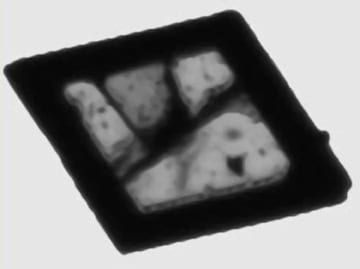
L-glutamic acid is a monotropic polymorphic compound. Transformation between the _- and _-polymorphs is solution-mediated. The _-polymorph of L-glutamic acid has a granular consistency (Figure 1a) whilst the _-form has a needle-like flaky structure (Figure 1b). For the production of monosodium glutamate the _-form is preferred as it is more robust; the _-polymorph tends to break during downstream handling and therefore processes less well. The _-polymorph is, however, the less stable form and therefore care needs to be taken during preparation to ensure that material with the required polymorphic specification is produced.
| |
 |
 |
| Figure 1a. _-form of L-glutamic acid | Figure 1b. _-form of L-glutamic acid | Figure 1c. _-Form of L-glutamic acid with _-Form nucleating off it and indication of polymorph transition from _- to _-Form |
The Morphologi G2 (Malvern Instruments) uses automated microscopy coupled with digital image analysis to measure particle size and shape in a statistically significant way. Size and shape data are easily generated and individual images of all the particles analysed are produced for visual scrutiny. Three batches of L-glutamic acid, A, B and C, were measured using the 2.5X magnification and a preset Standard Operating Procedure (SOP).
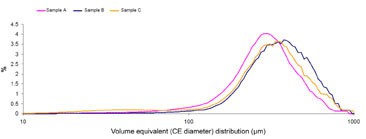 |
| Figure 2. Overlay of size distribution plot of the three samples |
Circularity is a measure of the ‘closeness’ of the particle to the shape of a perfect circle. High sensitivity circularity is calculated using the following formula:
HS Circularity = 4πA/P2 Where A=area and P=actual perimeter.
The Morphologi G2 stores the images of all the particles measured, together with the individual morphological parameters. The system also stores the x and y coordinates of every particle it measures, so individual particles can be examined more closely in manual microscope mode if required, at, for example, higher magnification. A study of the individual particle images for sample C reveals that many of the _-polymorph particles have _-polymorph crystals nucleated on their surfaces (Figure 1c). This indicates that with batch C there was a problem with the cooling process.
 |
| Figure 3. Overlay of the circulatory plot of the three samples |
 By Dr Deborah Huck. Deborah is Product Technical Specialist for Morphological Imaging Systems at Malvern Instruments, focusing on applications development and support.
Related Content

Siemens recognition for Bürkert enables improved development
Fluid control specialist Bürkert has become an official Siemens Product Partner for Siemen’s SIMATIC Automation Systems. The new partnership will …

Innovation in dialysis equipment
In 2022, more than 30,000 people were undergoing kidney dialysis in the UK [1], all of whom will require precision …
Liebherr launches new under-bench fridge and freezers for lab and healthcare providers
Liebherr, specialists in commercial refrigeration, have introduced its new range of under-bench fridges and freezers, engineered to meet the diverse …