
Discovery of first ever Laboratory News edition reveals true age…
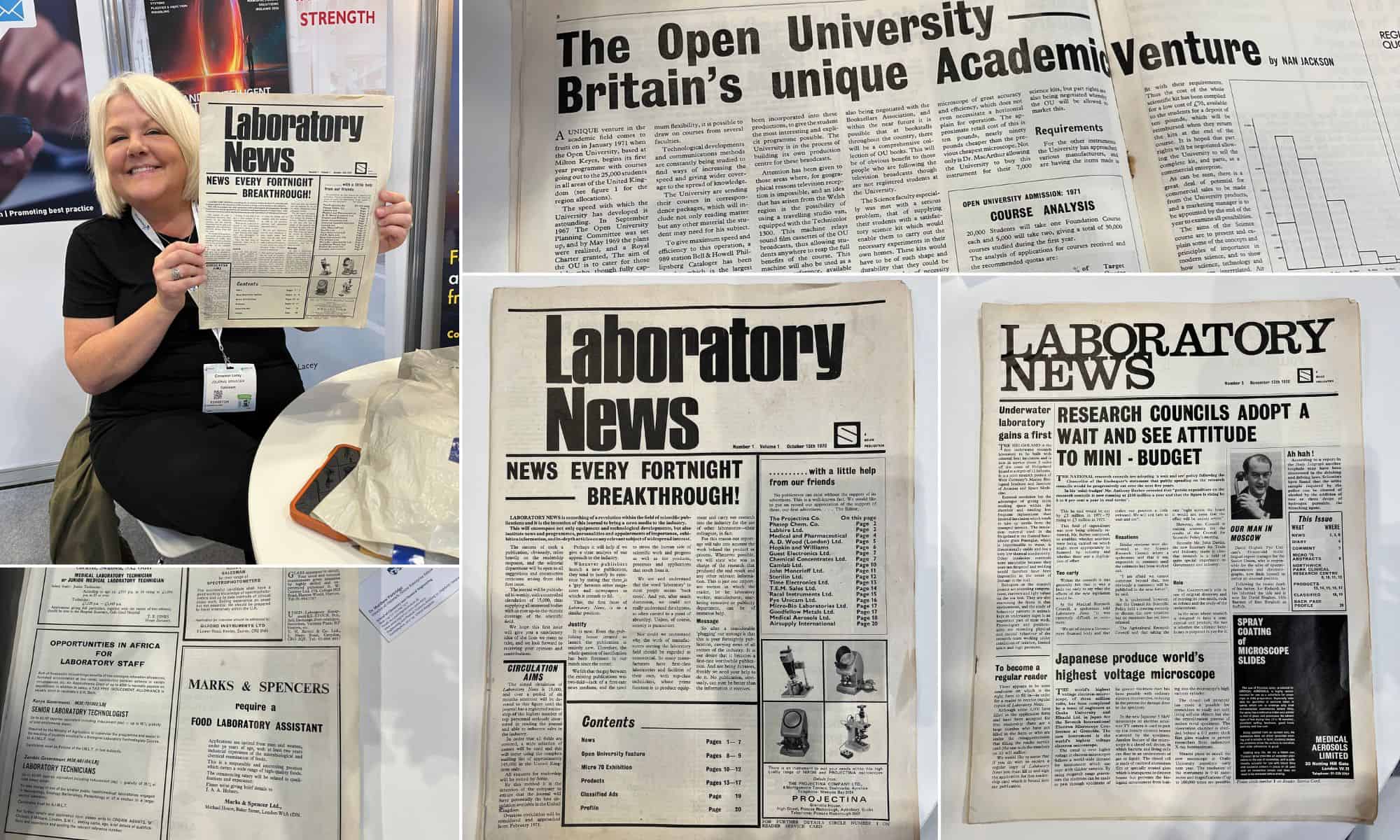
A rare surviving copy of the original launch issue of Laboratory News has been unearthed at the recent CHEMUK show.
And its publication date – 15 October 1970 – reveals the magazine began one year earlier than online sources including Wikipedia have maintained.
The copy came to light only as a result of the purchase of Laboratory News by Datateam Business Media in January this year.
Magazine staff were attending the annual CHEMUK show in Birmingham alongside colleagues from Datateam’s industrial publications arm.
Datateam journal manager Cinnamon Lacey (pictured) produced a copy of the first and third editions, both in a near perfect state.
“It was fantastic to get hold of and read the first edition,” said Laboratory News Laboratology columnist, Southampton university’s Dr Matthew Partridge, who was present at the show as a sessions moderator.
“From the paper it’s printed on to the adverts and articles, it’s like looking at a moment in lab history.”
Editor Brian Attwood, who was also attending the event, said both copies were in an astonishingly good condition that would do credit to an archive.
“There’s very little available about the early days of Laboratory News, hence the confusion even about the launch date. This has been a marvellous opportunity to connect with our past and the people without whose work there would be no publication today,” he added.
Issue 1 began with a statement of intent, to provide a “first rate news medium” and “stress the human side of scientific work and progress as well as the products, processes and applications that result from it”.
The lead feature focussed on another celebrated launch, that of the Open University – a move initiated by the previous Wilson government.
In the advertising section, a notable inclusion was one from Marks & Spencer, an indication of the burgeoning demand for scientists from the rapidly growing processed foods sector.
Meanwhile, the third edition led on UK research councils’ responses to plans by Tory chancellor Anthony Barber to cut their public investment. Alongside were articles about the first underwater laboratory and Japan’s production of the world’s highest voltage microscope.
Finally, it reported on spectrophotometer and chromatograph export manager David Hughes’ need for a change of business card for his clients in the then Soviet Union: the recent death of his father meant he had become the 14th baronet of East Bergholt.

