Double explosion changes view of star death
Witnessing a stellar explosion is unique enough – but to see two in the same location is unheard of. Until now that is.
Witnessing a stellar explosion is unique enough – but to see two in the same location is unheard of. Until now that is.
| |
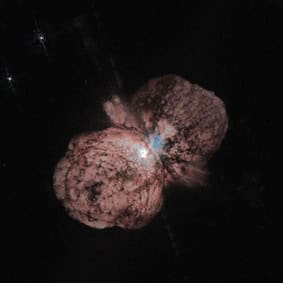
| This is an image of eta-Carina in our galaxy, taken with the Hubble Space Telescope. The star that exploded in 2004 and 2006 in the far off galaxy was similar to eta-Carina and doomed to death when its core collapsed to a black hole. (Credit: NASA/ESA Hubble Space Telescope and Jon Morse) |
A global collaboration of astronomers including Japanese supernova hunter, Koichi Itagaki, say this is the first time such a double explosion has been observed and challenges our understanding of star-deaths.
Team member Professor Stephen Smartt, of Queen’s University Belfast, said: “The supernova was the explosion of a massive star that had lost its outer atmosphere, probably in a series of minor explosions. The star was so massive it probably formed a black hole as it collapsed. This is the first time two explosions of the same star have been found, and it challenges our theories of the way stars live and die.”
In 2004, Koichi Itagaki discovered an exploding star in the galaxy UGC4904 (78 million light years away), which rapidly faded from view in the space of ten days. Never formally announced to the community, Itagaki then found a new, much brighter explosion in the same place only two years later, which he proposed as new supernova.
However, Professor Smartt and colleague Dr Andrea Pastorello immediately realised the implications of finding two explosions at the same position on the sky.
Dr. Pastorello said: “We knew the 2004 explosion could be a giant outburst of very massive star, and we know that only the most massive stars can produce this type of outburst. So the 2006 supernova must have been the death of the same star, possibly a star 50 to 100 times more massive than the Sun.”
Dr. Pastorello used UK telescopes on La Palma (the Liverpool Telescope, and William Herschel Telescope), in a combined European and Asian effort to monitor the energetics of SN2006jc. He showed that the exploding star must have been a Wolf-Rayet star - the carbon-oxygen remains of originally very high mass stars.
The observations have been reported in Nature magazine.