Future of thought
Following the opening of the NEURObotics exhibition at the Science Museum, Laboratory News considers how well you know your own mind
Following the opening of the NEURObotics exhibition at the Science Museum, Laboratory News considers how well you know your own mind
| |
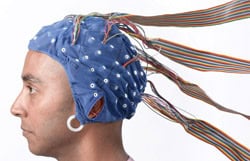
| With over 100 tiny metal electrodes, the berlin brain computer interface is the most advanced non-invasive system in the world |
Along a similar line is the Berlin brain-computer interface which has been developed to allow people to control an on-screen cursor with just the power of their mind. Created by German scientist Klaus-Robert Mueller and colleagues, people are able to use the device to control computers with their minds with only 20 minutes practice.
Simply by thinking about moving their left or right hands, researchers have used the interface to write messages and play simple computer games. It works by recording an individual brain print of what you're thinking. Some people can master two commands, while others can manage up to four. Mysteriously, 1 in 3 people can't control the interface at all, but no one knows why. With over 100 tiny metal electrodes, the Berlin brain-computer interface is the most advanced non-invasive system in existence (PIC 2).
If researchers can speed its processing power enough, the device could herald
 |
| An implanted chip picks up signals produced as you think about actions |
The prospect of achieving some independence because of these technological developments may be a dream come true for people that have suffered any kind of spinal cord injury. But there are potential problems with using complicated invasive surgery to implant these chips, not to mention the risk of infection.
Reading minds may be the stuff of sci-fi novels but it seems that's what's on the horizon if the 'Think your thoughts are private?' display is to be believed. It features brain-scanning technology that can be used to spot when we display stressed brainwaves – i.e. when we are lying. Traditional polygraphs are no longer as reliable as they once were as people have learnt how to beat the system. But is this type of scrutiny taking things too far? Larry Farwell uses his Brain Fingerprinting technology to detect details of a crime scene stored in a brain that only the guilty could know. Farwell measures suspects' brain waves using electroencephalography (EEG) while they look at words or pictures. When they recognise something, their brain sends out a characteristic brain-wave pattern, revealing that they remember that potentially incriminating detail. But can you trust the technology? Professor Steven Rose, neurobiologist, write and commentator says, "These technologies are in their infancy and the claims are made by enthusiasts. People will want much more evidence that these experiments have been scientifically validated."
A much more practical application of examining brain activity has been used recently, for the first time, scientists have used brain-imaging technology to detect that a patient apparently in a vegetative state is actually conscious. Adrian Owen and his team from Cambridge used a functional magnetic resonance imaging (fMRI) scanner to discover that a woman with severe brain damage is fully aware, and can communicate through her thoughts. The 23-year-old woman was in a devastating road accident in 2005 which severely damaged her brain and left her completely paralysed. Because she couldn't talk or move doctors had no idea if she was still aware, and she was diagnosed as being in a vegetative state.
In fact, doctors believe the woman may be conscious and aware of her environment, but unable to tell anyone in the outside world. Owen used an fMRI scanner (PIC 12)to discover if the woman was conscious or not by asking her to imagine doing tasks such as playing tennis.
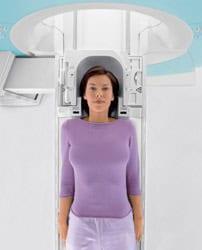 |
| An fMRI can be used to detect levels of brain damage |
This technology could be developed to help the woman communicate once again with the outside world. If she wants to say yes to a question she imagines playing tennis. If she wants to say no she imagines moving round her house. A cursor on a computer screen was programmed to go up or down depending on her answer. This could allow her to select different words, pictures or numbers on the screen, moving towards real-time communication. Although these results are amazing, this could be a one-off case because patients in a vegetative state often have much more damage to their brains than this patient, it's unlikely that many are actually conscious. However, in the future this technology could help to diagnose those rare cases where patients are actually fully aware of what's going on and have no way to communicate.
Enhancing performance is an entirely natural desire for human beings. Now it has been demonstrated that performance and creativity can be enhanced by having EEG neurofeedback treatment. Cassie Yukawa, a classical pianist, has demonstrated how this treatment improved her performance.
Improving mental skills of ordinary people can also be done by transcranial magnetic stimulation (TMS). By sending a short, strong magnetic pulse through its coil, this TMS machine affects the electrical activity of the brain. TMS can either activate a part of the brain or knock it out momentarily, depending on the pulse's frequency, and depending on the shape of the coil different effects can be seen. A figure-of-eight shape produces a more concentrated effect to target a specific area, while a saddle shape can reach deeper into the brain.
There is debate over how ethical improving brain performance in these ways is though – is it classified as an unfair advantage, or is it no more than employing a personal tutor?
With overviews into research as exciting as this, the Science Museum is sure to meet its target of generating interest and discussion in all visitors. The exhibition is running for the next three months, for more information visit www.sciencemuseum.org.uk
By Alexandra Bailey.
Alexandra is the editor of Laboratory News. She has a degree in Applied Human Biology from Aston University
Related Content

Siemens recognition for Bürkert enables improved development
Fluid control specialist Bürkert has become an official Siemens Product Partner for Siemen’s SIMATIC Automation Systems. The new partnership will …

Innovation in dialysis equipment
In 2022, more than 30,000 people were undergoing kidney dialysis in the UK [1], all of whom will require precision …
Liebherr launches new under-bench fridge and freezers for lab and healthcare providers
Liebherr, specialists in commercial refrigeration, have introduced its new range of under-bench fridges and freezers, engineered to meet the diverse …