Industrialisation of fundamental physics research advances light source and sensor technologies
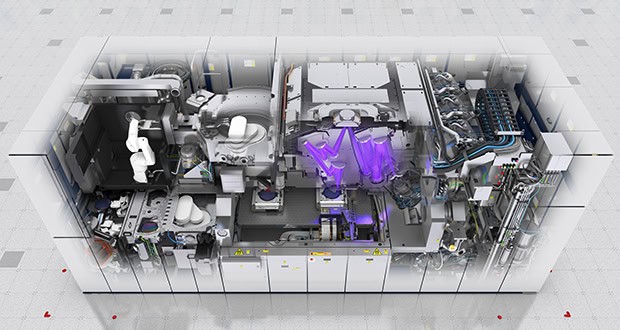
Collaboration between specialist academic research and industrial expert engineers is proving key to the accelerated transfer of research knowledge from lab to market and the advancement of real world light source and sensor technologies. One such industrial partnership will help create better performing, cheaper chips, which can be used in millions of electronics devices, as well as in healthcare tech and precision manufacturing. By applying research in optical metrology, physics can help solve real-world engineering challenges for the global semiconductor industry.
Image: Example of ASML's technology (EUV lithography system, NXE:3400…nsor) Credit: ASML
A leading academic team from Heriot-Watt University is partnering with ASML, a major international supplier to the semiconductor industry, driving the advancement of new light source technologies.
In a five-year collaboration partly funded by ASML, Professor John Travers’ research into fundamental physics will be accelerated, creating a direct route from lab to market for new laser technologies.
Using light to print semiconductor chips
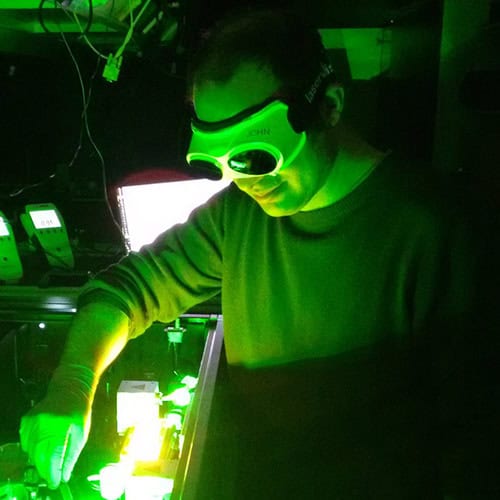
Image: Professor John Travers, Heriot-Watt University, uses a laser in the…att University Credit: ASML
ASML is the world’s leading manufacturer of semiconductor lithography machines. Based in the Netherlands, the company uses light to print tiny patterns onto silicon, resulting in the mass production of semiconductor chips. Precision is key to the printing technique. Optical metrology also uses light to establish the exact measurements required. Developments in this field allow top chipmakers to create better performing, cheaper chips.
Due to the value of each multimillion machine, it is vital that ASML continues to explore new directions for its technology to take.
Industrial partnerships to address real-world engineering challenges
The partnership resulted in a new laboratory at Heriot-Watt University which will accelerate the industrialisation of fundamental physics research. Professor Travers’ current focus is on new broad bandwidth light sources for optical metrology. The sensors in ASML’s machines must work at multiple wavelengths because they encounter various materials, each of which absorb in different ways.
Professor Travers’ team has already delivered several ideas that have been patented.
Professor Travers said: “The type of optical components used in recent research previously sat in the domain of fundamental physics research. Working in close cooperation with ASML is rapidly moving our work in the direction of the industrialisation of this technology, where we are addressing specific engineering challenges, and applying the technique to create real-world impact.
“My research into fundamental physics can be used by ASML in an industry setting. So often in academia, the focus is on advancing the science and impressing our peers. However, through this industrial partnership, we are addressing specific real-world engineering challenges, with industry and academia learning from each other.”
Further application of light source technologies
Application of the advances in light source technologies are not limited to semiconductor chip manufacture. There are also valuable uses for the technique in healthcare technology and precision manufacturing.
David Richardson, Chief Entrepreneurial Executive at Heriot-Watt University, said: “The work of Professor Travers and his team is hugely important to the advancement of light source and sensor technology. Through collaborations of this type, Heriot-Watt University can create greater cohesion between academic disciplines, industry partners and the global community.
“Industry leaders are increasingly recognising the value of bringing complex, technical issues to specialist universities and collaborating on the research, direction and engineering work they require. By accelerating the transfer of research knowledge from lab to market, Heriot-Watt is generating opportunities for R&D funding, attracting inward investment to Scotland and helping to elevate the country’s reputation in the field.”
Last year, Heriot-Watt University launched its Prospectus for Recovery and Growth, illustrating the institution’s commitment to supporting the global recovery efforts in relation to Covid-19. The Prospectus places collaboration, partnership and accelerating commercialisation at the heart of its approach.
Related Content

Rise in biochemical and chemical engineering UCAS numbers
Recent UCAS data has revealed a growing interest in biochemical and chemical engineering, says the Institution of Chemical Engineers (IChemE). The …
When plasma leaves the laboratory
The orbital laboratory is evolving into something more ambitious, a controlled industrial environment for producing next-generation materials, explains Ed Smith and Andrew Griffiths. …

Maths award adds up to nearly £2.8 mill for exchange research
Two of Sweden’s leading institutions have donated the equivalent of £2.78 million to fund 16 mathematicians for work ranging from …