MRI gives dementia early warning
New research suggests that Alzheimer’s disease could be detected several years before the symptoms start to manifest
New research suggests that Alzheimer’s disease could be detected several years before the symptoms start to manifest
| |
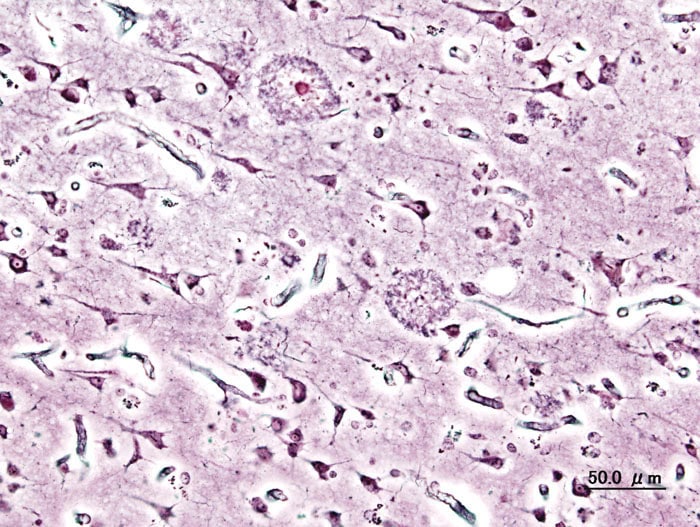
| Alzheimer's disease causes plaques in the cerebral cortex - but it could be spotted by an MRI scan before it takes hold |
Johanna Lind of the Karolinska Institutet carried out the work. “This is a crucial step towards the better diagnosis of Alzheimer’s,” she said. “If the method is developed it can help us find the people who’d benefit most from treatment in good time.”
The method is based on the well-established fact that the APOE protein affects the risk of developing Alzheimer’s. APOE is a lipid-transporting protein important in, amongst other things, the repair of cerebral neurons. Roughly one person in five carries a genetically determined variant of APOE that is associated with an increased risk of Alzheimer’s.
The study showed that some of the people in this risk group had reduced parietal lobe activity, detectable using MRI - and that these same people were the ones who went on to suffer memory deterioration two to three years later.
“It’s surprisingly difficult to diagnose Alzheimer’s with any certainty, but things are made easier if you know who runs the greatest risk. If genetic mapping, MRI and cognitive tests all suggest approaching Alzheimer’s, it might be an idea to start a course of treatment,” said Lind.