Researchers face Oblivion
October 17, 2007
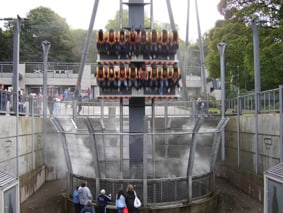
Scientists have helped to capture the essence of excitement with a live experiment that measured the thrill factor of riding a rollercoaster.
Scientists have helped to capture the essence of excitement with a live experiment that measured the thrill factor of riding a rollercoaster.
| |
| Oblivion’s vertical drop can induce “dark psychological” experiences |
The aim of the rider monitoring system, developed by computer scientists of the Mixed Reality Lab (MRL) at The University of Nottingham, is to help establish a definitive thrill factor across thrill rides worldwide and help to shape the next generation of rollercoasters.
Professor Steve Benford, of the School of Computer Science & IT at the University and one of the MRL’s principal investigators, said: “Our aim is to understand the impact that these rides have on people and to use this to help shape more responsive and exciting rides of the future.”
The equipment allowed physiological data to be recorded during the ride, including video of people’s faces, audio, heart rate, galvanic skin response and acceleration. Experts at the MRL were also involved in psychological profiling before and after the event.
For the event, Alton Towers joined forces with the world’s only “thrill engineer” - Brendan Walker - a former aeronautical engineer who specialises in the study of emotionally stirring experiences.
He said: “Oblivion’s success as one of the world's most exciting rollercoasters relies on a perfect synergy between extreme physical and dark psychological experiences, giving us a unique opportunity to study the science of thrills and shape the future of theme park rides.”
Related Content
No items found