Space gadget set to battle Earth bound infection
Technology developed for the Beagle 2 and Rosetta space missions could soon be harnessed to provide a cost-effective, rapid and accurate tool for diagnosing tuberculosis.
Technology developed for the Beagle 2 and Rosetta space missions could soon be harnessed to provide a cost-effective, rapid and accurate tool for diagnosing tuberculosis.
| |
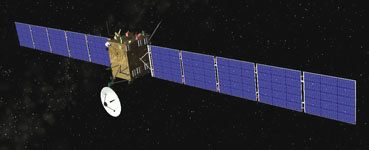
| Rosetta spacecraft |
TB, which is caused by the M. tuberculosis bacterium, is thought to kill two million people every year, primarily in the developing world. However, diagnosing TB in resource-poor settings relies mainly on the use of smear microscopy of sputum samples, a very labour-intensive process with low sensitivity.
Research leader Dr Geraint Morgan of the Open University said: “Smear microscopy is not a very accurate way of diagnosing TB and only detects a third of all positive cases. That means seven out of ten patients will effectively need to get worse before they can be diagnosed and treated. Clearly, we need a new solution to this problem.”
Now, researchers led by Dr Morgan and Professor Colin Pillinger at The Open University together with Dr Liz Corbett from the LSHTM will develop a portable mass spectrometer for diagnosing TB. The technology has been developed by the team behind the experiment that was to search for life on Mars during the Beagle 2 mission and the Ptolemy instrument currently on-board the European Space Agency’s Rosetta spacecraft.
“The thing with developing technology for space missions is that if forces you to push boundaries and think outside the box when you're looking for new solutions to challenging problems.” Said Dr Morgan. “Many of the technical challenges we have overcome in designing our space instruments are the same as we face with this issue.”
Launched in 2004, Rosetta will be the first spacecraft ever to conduct scientific measurements on the surface of a comet. The Rosetta Lander includes a shoe-box sized gas chromatograph mass spectrometer (GC-MS), known as Ptolemy, which will analyse small pieces of the comet’s nucleus to identify what it is made from and answer questions about the make up of the early Solar System.
Dr Morgan believes that they can adapt Rosetta's technology to develop a GC-MS capable of detecting TB in sputum with greater sensitivity than smear microscopy and significantly quicker than the alternative culture methods. The process could be automated, meaning that skilled laboratory technicians would not be needed, and would not need to be carried out in a special laboratory, making the technology more widely available in the places that need it most.