Double dose ultrasound delivers BPA water pollution breakthrough
Developments in ultrasound technology have provided a means for tackling difficult pollutants in water, avoiding the addition of chemicals in the process.
The Symes Group at University of Glasgow’s school of chemistry say their most recent application of sonochemistry techniques can erase 94% of traces of bisphenol A (BPA).
A common water contaminant throughout the world, BPA is used in plastics including food packaging and water bottles. An estimated 10 billion kilograms is produced every year.
Buildups of the pollutant in humans can impact the endocrine system and hormone production, affecting foetal development and are linked to several adult health conditions.
While ultrasound has been employed previously in tandem with other catalysts or chemicals, the Glasgow team focused on it as the sole means of tackling BPA, explained the researchers writing in Ultrasonics Sonochemistry.
Their dual-frequency approach exposed BPA molecules to contrasting combinations of either 20 kHz and 37 kHz or else 20 kHz and 80 kHz.
This generated millions of microscopic bubbles in the contaminated water, whose growth and collapse create high temperature and pressure ‘hotspots’ which broke the molecules into substances such as carbon dioxide, to remove the pollutants.
Dr Lukman Yusuf, the paper’s co-author with Dr Zeliha Ertekin, said: “The key to this approach is the quality of the bubbles we’re generating using ultrasound.
“We’ve shown in this that we can reliably generate bubbles with the conditions required to degrade BPA, building on previous research from the group which demonstrated its effectiveness in removing methylene blue, another common water pollutant.”
Tests of 40 minutes using the contrasting dual frequencies demonstrated the 20 kHz and 37 kHz was the more effective. It degraded 94% of BPA present in samples, with a 67% reduction in chemical oxygen demand.
The research paper’s first author, PhD Shaun Fletcher commented: “What we’ve been able to show for the first time is that ultrasound alone can offer an effective method of removing BPA from water.
“You don't need to worry about removing your catalyst or further purifying your water by removing anything you've added to it in the treatment process."
Yusuf added that the hope was to expand the technique to help tackle a wide range of pollutants, including ‘forever chemicals’ such as PFAs. He said the university was in discussion with water companies to explore the technology’s industrial potential.
Earlier this year, the Symes Group head by professor Mark Symes employed ultrasound for what it described as a “breakthrough” development producing nitrate from air and water, paving the way for sustainable development of fertiliser.
Symes said that the emergence of more affordable and sophisticated ultrasound technology meant that sonochemistry was starting to achieve its potential.
“Ultrasound won't replace conventional sewage treatment - those 120-year-old systems work fine for regular sewage and they're cheap. But we're going to see an increasing need for new solutions for targeted applications, particularly for these sorts of toxins,” he predicted.
“That's where ultrasound can really excel because the conditions inside those tiny bubbles are literally out of this world, yet we can stand right next to the process and watch the degradation happen without any protective equipment.”
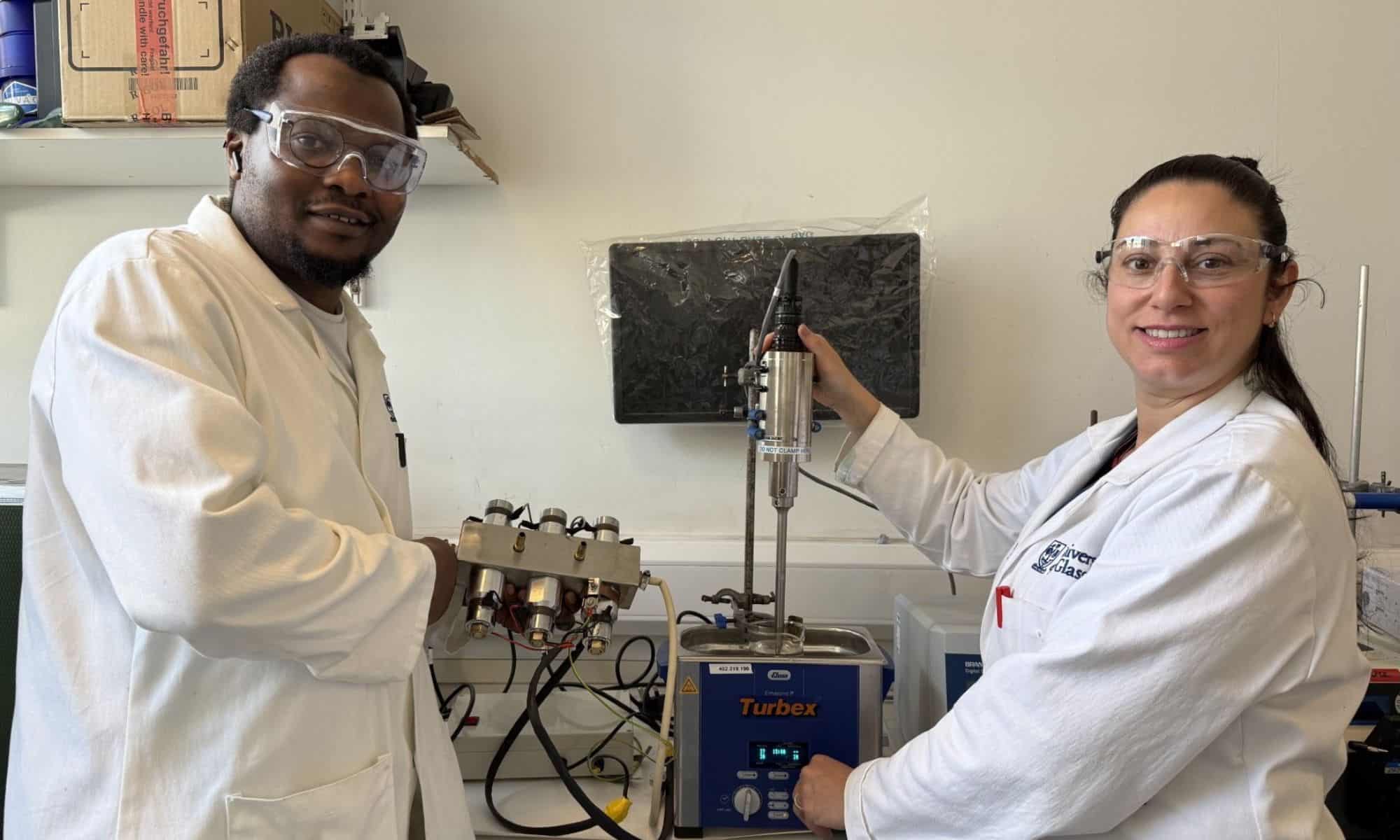
Pic: Dr Lukman Yusuf and Dr Zeliha Ertekin with an ultrasound system prototype
Related Content

When plasma leaves the laboratory
The orbital laboratory is evolving into something more ambitious, a controlled industrial environment for producing next-generation materials, explains Ed Smith and Andrew Griffiths. …
Lab gloves could inflate microplastics readings suggests study
Scientists may be overestimating their assessments of microplastics pollution, with the cause lying literally in their own hands, suggests a …
From Injection to Ingestion: Can yeast make vaccines more accessible?
Vilnius University reports how its Life Sciences (VU LSC) Center and the U.S. National Cancer Institute are exploring yeast-based oral vaccines …